

IFRS 16 requires leases to be recognised on the balance sheet. To ensure data traceability and compliance with audit standards, SAP CLM and SAP RE-FX work hand in hand, from the contract through to the accounting entry.
Why two tools where many see only one?
This is one of the most common mistakes in IFRS 16 projects on SAP: believing that a single tool is enough.
Some finance departments deploy SAP RE-FX and assume they have covered their entire lease portfolio. Others rely on SAP CLM to manage their contracts and assume that the accounting will naturally follow.
In both cases, something essential is missing.
RE-FX without CLM means rigorous real estate accounting, but blind spots on IT, fleet and equipment contracts that never make it to the balance sheet.
CLM without RE-FX means structured contract management, but an incomplete accounting chain, manual liability calculations and insufficient traceability for auditors.
IFRS 16 compliance is not an accounting problem. It is an end-to-end contract lifecycle problem.
And that is precisely why RE-FX and CLM are complementary, not interchangeable.
Two tools, two roles, one single chain
Before going into detail, it is important to understand the logic behind this division of roles.
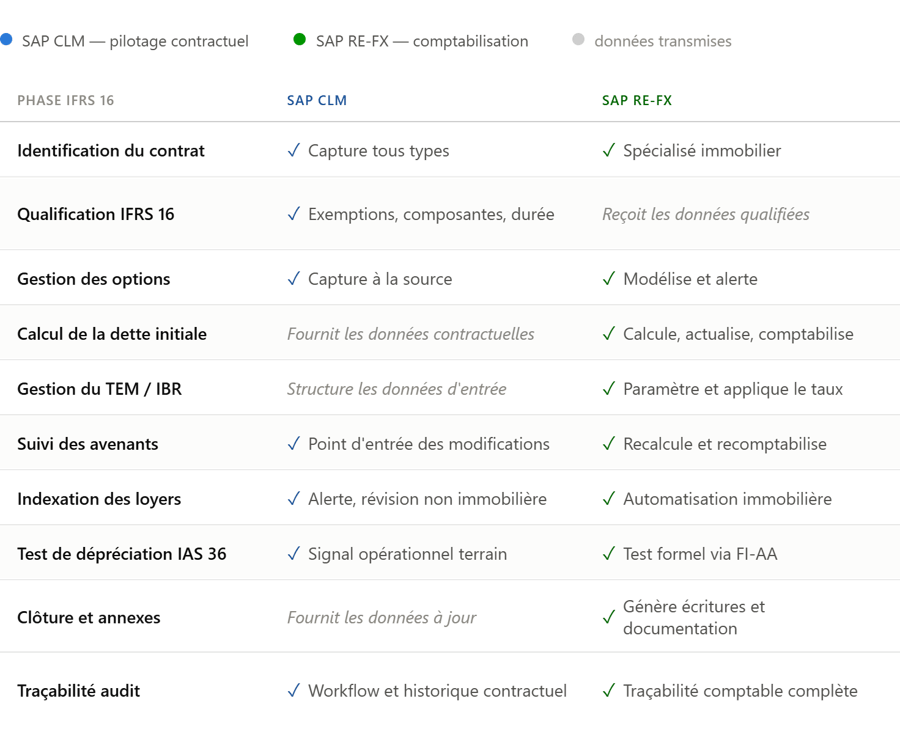
SAP RE-FX is the accounting and calculation tool. It produces the figures: lease liability, right-of-use asset, interest expense, RoU depreciation. It is natively integrated with SAP FI and SAP FI-AA. It is the accounting backbone of your IFRS 16 compliance.
SAP CLM is the contract management tool. It captures, qualifies, routes and monitors contracts throughout their life. It is the entry point for every change: amendment, indexation, renewal, termination. It is the operational backbone of your IFRS 16 compliance.
One calculates. The other organises. One posts the entries. The other raises the alerts. One produces the disclosures. The other secures the data upstream.
Together, they cover the entire IFRS 16 cycle, from contract signature through to year-end close.
IFRS 16: 10 Mistakes Avoided Thanks to the SAP RE-FX and CLM Duo
Implementing IFRS 16 calls for rigorous processes, where every parameter has a direct bearing on the reliability of the financial statements. Yet certain mistakes come up again and again in compliance projects.
Mistake 1: Overlooking embedded leases
The fundamental problem with poorly defined IFRS 16 scopes is a question of tooling: no single system can cover everything.
SAP RE-FX was designed for real estate leases. It excels at managing commercial leases, land, warehouses and offices, with detailed modelling of real estate objects, floor areas and lease financial conditions. It automatically generates the IFRS 16 entries as soon as the real estate contract is created in the system.
SAP CLM covers what RE-FX does not see: non-real-estate contracts such as vehicle fleets, IT hardware, servers, industrial equipment and managed services contracts with a dedicated asset. CLM captures them from creation, assesses them against IFRS 16 and passes them to accounting for processing. Without CLM, these contracts stay in spreadsheets or emails, invisible on the balance sheet.
Complementarity in practice: RE-FX covers the real estate side of the balance sheet. CLM covers the non-real-estate blind spots. Together, they eliminate the scope gaps that are the leading cause of discrepancies during IFRS 16 audits.
Mistake 2: Misapplying the exemptions
SAP RE-FX handles exemptions on real estate contracts: leases below the low-value threshold, remaining term of less than 12 months. The contract is automatically excluded from the IFRS 16 calculations and switched to a direct operating expense, with no manual accounting intervention.
SAP CLM applies the same exemption logic to non-real-estate contracts, right from the contract qualification stage. A low-value equipment lease is identified and excluded before it is even passed on to accounting, avoiding unnecessary downstream workload.
Complementarity in practice: RE-FX applies the exemptions at the accounting output stage. CLM applies them at the qualification input stage. Together, the two ensure that no contract is either forgotten or over-recognised, whatever its type.
Mistake 3: Failing to separate the lease component from the service component
SAP RE-FX performs this separation on real estate leases: recoverable service charges, landlord insurance and common-area charges are configured as distinct components and excluded from the discounted base. Only the net rent enters the IFRS 16 liability calculation.
SAP CLM carries out the same separation upstream, on mixed non-real-estate contracts. In a fleet contract covering maintenance, insurance and roadside assistance, CLM isolates the pure lease component — the only one that will be passed on for IFRS 16 recognition — from the service components, which remain operating expenses.
Complementarity in practice: RE-FX separates the components after initial recognition. CLM separates them before transmission. Together, they ensure the liability calculation base is correct from day one, for every type of contract.
Mistake 4: Underestimating the impact of the incremental borrowing rate (IBR)
This is where the difference in role between the two tools is most pronounced.
SAP RE-FX is the reference tool for managing and applying the IBR. It allows differentiated rates to be configured by currency, by legal entity and by maturity, linked directly to each real estate contract. The IBR is calculated, applied and documented in RE-FX with full traceability, which forms the centrepiece of IFRS 16 audit documentation.
SAP CLM does not calculate the IBR — that is not its role. But it structures the contract data that determines whether the rate is correctly applied: contract currency, non-cancellable term, signing legal entity, geographical location. A contract that is poorly documented in CLM — wrong currency, approximate term, and so on — will inevitably lead to a miscalibrated IBR in RE-FX, with knock-on consequences across all the calculations.
Complementarity in practice: CLM supplies the data. RE-FX is the calculation engine. The quality of the IBR depends as much on the rigour of data entry in CLM as on the configuration in RE-FX. Both must be flawless.
Mistake 5: Misassessing the lease term by overlooking options
SAP RE-FX models renewal and termination options within the structure of the real estate lease and triggers preventive alerts ahead of the option deadline. As soon as the team confirms or rules out exercising the option, RE-FX automatically recalculates the term applied, the discounted liability and the RoU depreciation schedule.
SAP CLM plays an even earlier role: it is CLM that captures contractual options from the moment the non-real-estate contract is drafted or entered. If a renewal option is not recorded in CLM at the outset, it will not exist in the data passed on to accounting and will therefore never be factored into the IFRS 16 lease term. CLM is the first line of defence against missed options.
Complementarity in practice: CLM captures the option at source. RE-FX models it and triggers the alert at the deadline. Without CLM, the option does not exist in the system. Without RE-FX, it does not trigger an automatic recalculation. Both links in the chain are indispensable.
Mistake 6: Omitting initial direct costs and lessor incentives
SAP RE-FX incorporates agency fees, security deposits, rent-free periods and landlord contributions as financial components of the real estate contract. They are automatically included in the calculation of the initial RoU value, with no parallel manual entry in FI-AA.
SAP CLM makes it possible to document the initial financial conditions of non-real-estate contracts — supplier discounts, set-up fees, financial conditions precedent — and to pass them on to accounting in a structured form. Without CLM, this information stays in emails or local files, invisible at the point of initial recognition.
Complementarity in practice: RE-FX automates the inclusion of initial adjustments for real estate leases. CLM ensures they are reported for non-real-estate contracts. Together, they guarantee an accurate and complete initial RoU value across every type of asset.
Mistake 7: Failing to capture in-life modifications and amendments
This is probably where the complementarity of the two tools matters most.
SAP RE-FX handles accounting remeasurements on real estate leases. As soon as an amendment is recorded, it recalculates the discounted liability, updates the RoU depreciation schedule and generates the modification entries — with no break in the flow and no manual intervention.
SAP CLM is the entry point for every contractual change, including for non-real-estate contracts. CLM captures the amendment, submits it to the appropriate approval workflow (legal, procurement, finance) and passes it on for accounting remeasurement. Without CLM, amendments circulate by email, reach accounting late and create synchronisation gaps that are difficult to make up at closing.
Complementarity in practice: CLM detects the event. RE-FX drives the remeasurement. An amendment not captured in CLM will never trigger a recalculation in RE-FX. A recalculation triggered in RE-FX without reliable data from CLM will produce an erroneous result. The chain only exists if both links are active.
Mistake 8: Not testing right-of-use assets for impairment (IAS 36)
SAP RE-FX, working with SAP FI-AA, treats the right-of-use asset as a fixed asset in its own right. Impairment indicators can be configured to trigger automatic alerts at period-end. It is in FI-AA that the IAS 36 test is formalised, documented and made defensible in an audit.
SAP CLM contributes upstream: it keeps the operational status of contracts up to date (active, suspended, terminated early, site closed). A contract flagged as “inactive” or “site closed” in CLM can automatically trigger a potential impairment signal to the finance teams, creating a direct link between operational reality on the ground and the IAS 36 accounting test.
Complementarity in practice: CLM detects the operational signal. RE-FX / FI-AA formalises the accounting test. Without this link, the IAS 36 test remains a manual exercise carried out at the end of the closing period, with no real-time visibility over potentially impaired assets.
Mistake 9: Mishandling index-linked variable lease payments
SAP RE-FX is natively designed for real estate indexation clauses. Reference indices (ILAT, ICC, ILC) are linked directly to the contract. At each index revision, RE-FX automatically recalculates future rents, updates the discounted liability and generates the accounting entries, with no manual intervention whatsoever.
SAP CLM handles price revision clauses on non-real-estate contracts: annual revision of fleet charges, adjustment of IT equipment rentals, revision of managed services terms. It triggers revision alerts on the right dates and passes the new amounts to accounting for remeasurement.
Complementarity in practice: RE-FX automates real estate indexation end to end. CLM secures non-real-estate contract revisions and alerts the right people at the right time. Together, they eliminate the risk of a liability that is systematically out of step with contractual reality across the entire portfolio.
Mistake 10: Running everything on Excel and working in silos
SAP RE-FX replaces Excel across the real estate scope by automating the entire IFRS 16 chain: liability calculation, RoU recognition, depreciation schedule, closing entries and production of the disclosures. Every change is traced, time-stamped and defensible in an audit.
SAP CLM replaces Excel across the non-real-estate scope and breaks down organisational silos. It connects the Procurement, Legal, Real Estate and Accounting teams in real time around a single source of data. An amendment signed by Procurement is immediately visible to Accounting — no email, no shared file, no risk of it being overlooked.
Complementarity in practice: RE-FX eliminates Excel on the real estate accounting side. CLM eliminates Excel on the non-real-estate contract management side. Together, they replace the whole scattered collection of spreadsheets with an integrated, traceable and auditable chain — from contract qualification through to automated closing entries.
In summary: RE-FX and CLM, two tools for compliance with no blind spots
Conclusion
IFRS 16 compliance is not a purely accounting matter. It is a question of contract governance, data quality and process automation across the entire contract lifecycle.
SAP RE-FX on its own covers real estate accounting. It is rigorous, integrated and auditable — but blind to non-real-estate contracts and dependent on the quality of the data it receives.
SAP CLM on its own structures contract management. It is comprehensive, cross-functional and collaborative — but it does not calculate, does not post entries and does not produce the IFRS 16 accounting records.
Together, they form the only SAP answer capable of covering the entire IFRS 16 scope: from identifying the first contract through to the last closing entry, with no blind spots, no manual data entry and no risk of a disconnect between contractual reality and the balance sheet.
This is not a matter of tool preference. It is a matter of compliance architecture.
Lumveris: SAP Strategic Solutions & AI – SAP RE-FX, SAP CLM, Finance & Operations, and Real Estate Management Specialist – contact@lumveris.eu · lumveris.eu
